The Three Categories of AI Engineering, Revisited
A while back, I wrote about three ways AI intersects with software engineering. Category 1: using AI tools to build software. Category 2: building software that uses AI. Category 3: building the AI itself.
That was roughly 2.5 months ago.
If you haven’t read yet, link here: https://medium.com/@manojisnow/three-types-of-ai-work-in-software-development-and-the-one-i-think-we-should-master-d76971a0bdb4
I am not exaggerating when I say almost everything inside each category shifted in that time. The framework held. The contents changed. If you read the original and nodded along, this follow-up is worth your time — because operating from a mental model that is even 10 weeks out of date puts you behind in ways that compound quickly.
Let me walk through each one.
Category 1: From Agent to Ecosystem
When I wrote the original, the example I used was Copilot suggesting a line of code. You still had to think, type, review, commit. The AI was riding shotgun.
Then I upgraded that framing: AI tools are agents now. Claude Code opens files, runs tests, fixes failures, raises pull requests. You describe the outcome, go make a coffee, come back to a clean diff. That framing was accurate 10 weeks ago.
It already needs another upgrade.
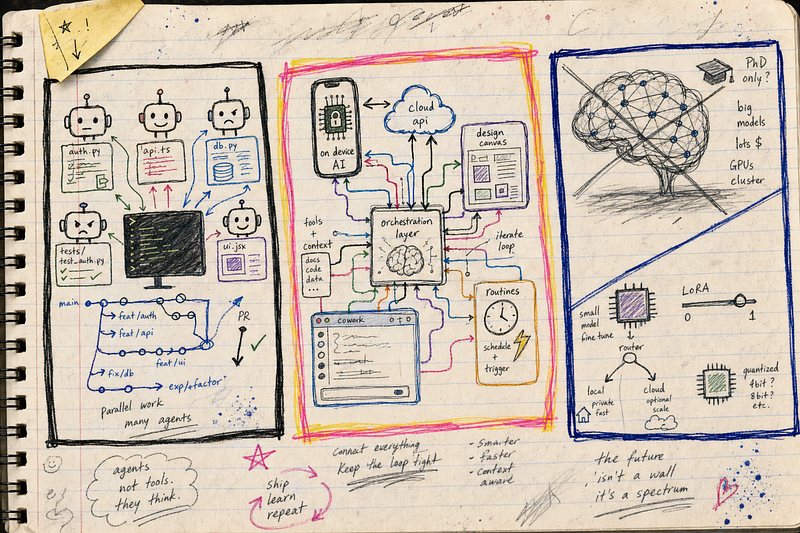
Category 1 is no longer one tool per developer. It is an ecosystem of coordinated agents per project. OpenAI Codex now ships parallel task forking that auto-resolves merge conflicts. Claude Code runs parallel sessions in separate Git worktrees, monitors CI, fixes failing checks automatically, and sends long-running work to the cloud so it continues after you close the laptop. You do not pick one agent per repository anymore — you orchestrate several, each with a focused scope, collaborating on the same codebase.
And then OpenClaw arrived.
Jensen Huang called it the “operating system for personal AI” at GTC 2026, comparing it to Linux and Kubernetes in terms of timing and industry impact. The comparison landed. OpenClaw hit 321,000 GitHub stars in 60 days, surpassing React’s 10-year record. You define “claws” — agents that wake up, take actions, invoke tools, write code, and complete tasks autonomously while you sleep. It is model-agnostic: Claude, GPT, Gemini, Grok, or local models through Ollama all work. The agent does not just assist you. It acts as you.
That last line is where the conversation gets serious.
The first wave of CVEs followed fast — remote code execution, SSRF, authentication bypass, path traversal. Bitdefender found roughly 900 malicious packages on ClawHub, OpenClaw’s skill registry, about 20% of all published skills. An agent with full desktop permissions and a compromised skill is not a chatbot that says the wrong thing. It is a system acting with your identity, your access, and your credentials.
Which is why NemoClaw matters. NVIDIA’s open-source security layer, announced at GTC 2026, wraps OpenClaw in a kernel-level sandbox, an out-of-process policy engine that compromised agents cannot override, and a privacy router that keeps sensitive data on local Nemotron models while routing complex reasoning to the cloud. Think of it as the enterprise-ready distribution of OpenClaw rather than a competitor to it. It is still early alpha — Q3 2026 is the sensible evaluation window for production use — but its existence signals that the industry already knows the trust problem is real.
The mental model for Category 1 in mid-2026: you are not a developer with an assistant. You are an architect running an agent fleet. Your job is system design, scope definition, output validation, and making sure the guardrails hold.
The cost story also changed completely.
Ollama v0.23 shipped this week with ollama launch claude-desktop -- a single command that bridges local inference directly into Claude Desktop. You set two environment variables, point Claude Code at Ollama's Anthropic-compatible endpoint on port 11434, and the agent runs against whatever model you have locally: Qwen3.6:27b, GLM 4.7 Flash, Codestral. Zero API fees. Zero data leaving your machine.
On an M3 Max Mac, Qwen3.6:27b hits 77.2% on SWE-Bench Verified — roughly 88% of what Claude Opus 4.7 achieves. For most day-to-day coding tasks, that gap is not noticeable in practice. For a 20-person team, the economics of a shared Mac Studio running a local model versus paying cloud API rates per token per developer is not a close comparison.
And if you need frontier quality without local hardware, Ollama Cloud models — DeepSeek V4-Pro (1.6T parameter MoE, 93.5% on LiveCodeBench), GLM-5.1, Kimi K2.6 — route through Ollama’s API using the same two environment variables. Frontier reasoning when you need it. Local inference when you don’t. Same toolchain throughout.
Category 2: From API Call to Agentic Workflow Platform
This was the central argument in the original article. Category 2 — building software that integrates AI as a capability — is where most engineers find their real leverage. That still holds. But the tools available to Category 2 developers shifted substantially in the last 10 weeks, and not just for developers.
Cowork changed who does Category 2 work.
Here is something that happened inside Anthropic before it shipped publicly: non-technical teams — marketing, finance, operations, data — started quietly bypassing Claude’s chat interface and using Claude Code instead. They wanted multi-step work done, not single-prompt answers. Anthropic watched this pattern and built Cowork: the same agentic architecture as Claude Code, wrapped in a desktop interface that does not require a terminal.
Cowork is not a chatbot. You give it an outcome. “Read the project brief in brief.docx, search for the latest market trends, and create a PowerPoint with key themes organised by topic.” Cowork reads every document, runs web searches, identifies recurring themes, and delivers a structured presentation. You did not coordinate each step. You described the goal once and reviewed the result.
The scheduled tasks feature is where daily workflows quietly change. You tell Cowork to pull your metrics from the analytics dashboard and update the weekly report template every Friday. You set it once. You stop doing that task manually. This is what “agentic” actually means at the product level — not a smarter autocomplete, but a persistent executor that owns recurring work.
For developers, Cowork and Claude Code are now both tabs in the same desktop application. Claude Code handles the codebase. Cowork handles documentation, research synthesis, data analysis, and file management. The design pipeline for building a SwiftUI app today looks like: describe the UI in Stitch, iterate visually, export the DESIGN.md, bring it into Cowork to generate component specs, feed those into Claude Code to build. Each stage uses the right tool. The handoffs are structured files, not copy-paste.
Stitch changed where design lives in the Category 2 workflow.
Google launched Stitch at I/O 2025 as a modest Google Labs experiment. The March 2026 update turned it into something that sent Figma shares down 4% on announcement day and 35% year-to-date.
Stitch is an AI-native infinite canvas powered by Gemini. You describe an application flow in plain language and it generates up to five interconnected screens simultaneously — not wireframes, but high-fidelity mockups with consistent design systems, proper component hierarchy, and sensible spacing. A product manager can describe a checkout flow and get back a cart page, shipping form, payment screen, confirmation page, and order tracker in roughly three minutes. All visually consistent. All exportable to Figma or React code.
The voice canvas is the feature that surprises people. You speak directly to the canvas. “Give me three different menu options.” “Show me this screen in dark mode.” The AI gives real-time design critiques, asks clarifying questions, and makes live updates as you talk. It is less like using a design tool and more like having a design conversation.
For engineers who never had design skills, Stitch removes the blank canvas problem entirely. The first 80% of a UI — getting from nothing to a credible starting point with a coherent visual language — is now a 20-minute job that costs nothing. Stitch also ships a DESIGN.md format and an MCP server, so designs flow directly into Claude Code or Cursor without manual handoff. The design-to-code pipeline is now as automated as the code-to-deployment pipeline was a few years ago.
Claude Design closed the design-to-code gap entirely.
Stitch was Google’s answer to design. Anthropic shipped its own on April 17: Claude Design, powered by Opus 4.7, the same model that now sees images at higher resolution and is described as more tasteful and creative on professional tasks.
The key differentiator is what happens at onboarding. Claude Design reads your existing codebase and design files and builds a design system from them — your actual colours, typography, and components, not a generic palette. Every project after that starts already on-brand. No manual token setup. No brief to a designer. The system is inferred from what you already ship.
From there, you describe what you need. You get a first draft. You refine through conversation, inline comments, direct edits, or adjustment sliders that Claude generates for the specific controls your design needs — spacing, colour intensity, type scale. The output is live HTML, not a static image. Clickable. Testable. When it’s ready, one instruction hands the whole bundle to Claude Code for implementation.
Datadog’s product team reported compressing a full week-long cycle of briefs, mockups, and review rounds into a single Claude Design conversation. Brilliant found that pages needing 20 or more prompts in other tools needed 2 in Claude Design. That is beyond just an incremental improvement in design tooling. That is the design-to-code pipeline becoming part of the same agentic stack as the rest of the Category 2 workflow.
Routines turned Claude Code into infrastructure.
Also on April 14 — three days before Claude Design — Anthropic shipped Routines for Claude Code. This one lands squarely in both Category 1 and Category 2 territory.
A routine is a saved Claude Code configuration: a prompt, one or more repositories, and a set of connectors, packaged once and run automatically on Anthropic’s cloud infrastructure. Your laptop can be closed. The routine still runs.
Three trigger types: schedule (nightly, weekly, hourly — your call), API (POST to a per-routine endpoint from any external system), and GitHub events (pull requests, releases, pushes). A single routine can combine all three.
The practical examples are where this gets concrete. A nightly routine reads your issue tracker, applies labels, assigns owners based on the code area referenced, and posts a summary to Slack so the team starts the day with a groomed backlog. A monitoring alert POSTs to the routine’s API endpoint, the routine correlates the stack trace with recent commits, and opens a draft PR with a proposed fix for on-call to review. A GitHub trigger fires on every pull request, the routine applies your review checklist, leaves inline comments, and posts a summary before human reviewers even open the diff.
What this means for software products: the automation layer is no longer cron jobs and bespoke scripts tied to someone’s machine. It is a Claude Code session with access to your repos and connectors, running on managed infrastructure, triggered by the events your system already emits. Engineers building products that integrate AI now have access to the same infrastructure primitives to automate their own development and operational workflows. The toolchain and the product are eating each other.
The three-tier model stack is now the standard architecture for Category 2.
On-device first: Apple Foundation Models via the Foundation Models framework for SwiftUI apps, or a local Ollama model for anything else. Free inference, private, offline, near-zero latency. Right for classification, summarisation, extraction, light Q and A.
Mid-tier: Sonnet-class cloud API calls for more complex reasoning. Pay per token, but use it selectively.
Frontier: Opus or GPT-class models for genuinely hard long-horizon tasks where quality matters and cost is secondary.
A well-designed Category 2 product routes across all three tiers automatically. The engineer’s job is designing those routing rules, not picking one model and hoping it handles everything.
Category 3: A Spectrum, Not a Wall
The original framing was honest about the barrier. Training your own models requires ML expertise, massive compute, curated datasets, and months of iteration. That is still true for frontier models.
But two things changed the lower end of Category 3.
Fine-tuning became a weekend project. LoRA fine-tuning a 3B parameter model on domain-specific data — proprietary code patterns, specialised legal language, a niche technical domain — is now something a small team can execute with off-the-shelf tooling and commodity hardware. The result often outperforms a general frontier model on that specific task at a fraction of the API cost. That is Category 3 work. It is not building GPT-5, but it is building an AI system that did not exist before you made it.
The open-weight models also crossed a threshold. Qwen3.6:27b hits 77% on SWE-Bench. GLM-5.1 leads SWE-Bench Pro among open-weight models. DeepSeek V4-Pro is a 1.6T-parameter mixture-of-experts with a 1M-token context window. These are not “good enough for hobbyists” models. They are production-grade systems that any engineer can deploy, fine-tune, and serve without negotiating API terms with a lab.
NemoClaw’s privacy router is also a Category 3 signal worth paying attention to. It routes sensitive data to local Nemotron models, reserving cloud calls for tasks where the local model cannot handle the reasoning load. Engineers building those routing policies are doing Category 3 work — model selection logic embedded in infrastructure — even if they never trained a single weight.
Category 3 is no longer a hard wall. It is a spectrum. Fine-tuning a small model sits at one end. Training a foundation model sits at the other. The near end is legitimately accessible now, and it blurs into Category 2. “Should I use a general model via API, or fine-tune a small model for my specific case?” is a real architectural decision that any software engineer should be able to reason through in the times ahead.
Where the Categories Now Overlap
The original framework did not fully capture this: the categories bleed into each other, and the most interesting engineering happens at the seams.
OpenClaw sits at the Category 1 and Category 2 boundary. It is a tool for building software, but building a trustworthy OpenClaw setup means designing agent orchestration, permission models, and context pipelines. That is product engineering, not just tooling use.
Cowork sits at the same boundary differently. Non-developers using Cowork to automate their workflows are consuming Category 2 software. Engineers building Cowork plugins and skills are doing Category 2 development. The product and the toolchain became the same thing.
Stitch’s DESIGN.md and MCP server sit at the Category 2 and Category 3 boundary. Exporting a design system as a structured, agent-consumable file is not far from defining a domain-specific context for a model. The line between “I gave the AI useful context” and “I built a specialised AI capability” is increasingly thin.
The framework is still useful as a map. But the territories share borders now, and the engineers who move fluidly across them are the ones doing the most interesting work.
What This Means for You
Category 1 tools are no longer optional. If you are not using an agentic coding tool in your daily workflow, you are at a productivity disadvantage — not a marginal one. And if API cost was the reason, Ollama on local hardware removes that excuse entirely.
Category 2 is where product differentiation is being built right now. The integration stack — on-device, mid-tier, frontier — is the new architecture pattern. Context pipeline design, model routing, probabilistic output handling: these are the engineering skills that build the next generation of software. This is where learning time should go.
Category 3 awareness is increasingly a senior engineering skill even if you never train a model. Fine-tuning tradeoffs, model evaluation, routing policy design — these are architectural decisions that belong in the same conversation as database selection and API design.
The engineers doing the most interesting work right now are probably asking: for this specific problem, what is the right combination of agent tooling, integrated AI capability, and model-level customisation?
That question, and the ability to answer it with concrete tooling choices, is the engineering skill of mid-2026. Exciting times to live in!
What changed in your stack in the last few months? I would genuinely like to know where your biggest surprises landed.