Rewired.
This is a case study of three generations of a family, my family, each one of our families, to reveal how humanity trades individual brilliance for collective magic.
How a Chennai family’s story reveals humanity’s greatest cognitive leap!
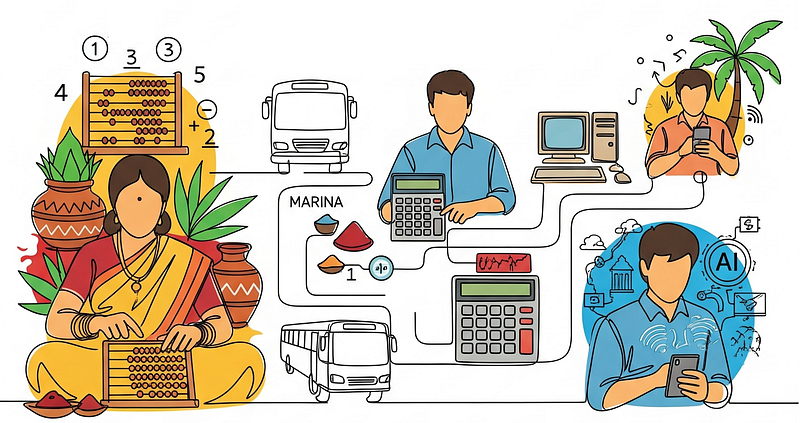
Amma: The Living Calculator
Our amma operated like a human Tally software, but faster. Every morning in our kitchen, she performed calculations that would make CA students sweat. 250 grams rice at ₹20 per kilo, multiply by 1.3 for my growing appetite, add 200 grams for unexpected guests, factor in tomorrow’s vazha-ilai lunch. All computed instantly while stirring sambar, listening to Vividh Bharati and arguing with the vegetable vendor. Her mind held a complex database: rice prices across three local shops, seasonal vegetable availability, and the exact timing needed for sambar to be ready when our father returned.
She managed household accounts entirely in her head, tracking ration shop credit, chit fund contributions, and festival savings across mental ledgers more organized than any Excel sheet. When Kamala aunty borrowed ₹500 three months ago, amma remembered the exact date, the reason (son’s school fees), and that it was supposed to be returned after Deepavali bonus.
Think of the waiter at Adyar Ananda Bhavan who memorizes the entire menu and recites our order like an ancient Tamil poet. Prices, modifications, accompaniments , all of that, never writing anything down. That’s how our amma managed a household of four. Her spatial memory was extraordinary too, like a human GPS for every item in the house. She knew the precise location of every item in the house, from the extra soap bar hidden behind the pickle jars to seasonal clothes stored in specific trunk corners.
Appa: The Human Google Maps with Heart
My appa’s mind was like Google Maps merged with WhatsApp status updates. Long before GPS, he knew every Chennai street like his own palm lines. We lived in Tiruvallur, but he was a bus conductor for MTC. Not just the main roads, but which narrow lane shortcuts to take during festival season, where auto-rickshaws got stuck during monsoon, and the exact timing when school kids flooded Luz Circle.
As a bus conductor, his brain processed live data that would crash modern computers: passenger flow patterns, optimal route changes, cash calculations for 2000+ daily transactions, tendering change with 0-error margin, while remembering that the regular uncle gets off at Thyagaraya Nagar every Tuesday for music class, and the college girl needs change for ₹500 note every month-end.
Beyond navigation, he was Chennai’s human social network. He knew family dramas of regular passengers, carried messages between neighborhoods like a two-legged telegram service, and maintained contact details of hundreds of people; functioning as living Facebook with emotional intelligence no smartphone could match.
Remember those manual laborers on the streets of Parry's corner whose hands spin like the fastest machines while making garlands out of flowers? That’s how our appa’s mind worked; processing complex information at superhuman speed through pure practice and necessity.
Me, Us: The Bridge Generation
We learned by watching. Sitting beside amma during grocery shopping, we absorbed her mental arithmetic. Following appa traverse the city on busy days, we internalized his route optimization logic. This wasn’t formal education. It was cognitive osmosis.
We developed foundational skills before calculators arrived. We could estimate autorickshaw fares mentally, navigate T. Nagar’s maze without help, and organize school projects through mental planning. When technology arrived during our college years, we used it as amplification, not replacement.
Calculators enhanced our speed but we understood the underlying math. Computers made work efficient but we retained analytical thinking. Mobile phones improved communication but we could still have meaningful face-to-face conversations. We represented the perfect hybrid; traditional cognitive resilience powered by digital tools.
We could switch between mental calculation and calculator, between intuitive navigation and Google Maps, between memory-based planning and digital organization. This cognitive flexibility made us the bridge between two worlds.
The Children: The Digital Native
But here’s the crucial part: my son learns what he sees me do, not what I learned from my parents.
Where I watched amma perform mental gymnastics, he watches me reach for calculator apps for simple additions. Where I observed appa’s spatial reasoning, he sees me consulting GPS for familiar routes to Spencer Plaza or Phoenix mall. Where I learned organizational skills through mental observation, he witnesses me depending on smartphone reminders and digital task managers.
His brain will optimize for different capabilities entirely. He’ll navigate complex apps intuitively, process multiple information streams simultaneously, and coordinate global networks that would overwhelm previous generations. But, when he grows up, ask him to calculate the area of our Madipakkam flat without a calculator, or navigate to Marina Beach without GPS, and he might struggle with tasks that seemed elementary to his grandparents.
He’s not becoming dumber, he’s becoming different. His cognitive architecture assumes unlimited external processing power and instant access to global information. He’ll solve problems my parents couldn’t imagine, but might feel helpless when digital infrastructure fails.
The Pattern: Every Generation Fears the Loss, Misses the Gain
This transformation isn’t unique to my family; it’s humanity’s oldest story of progress through cognitive offloading.
When humans invented writing 5,000 years ago, we had storytellers who could recite the entire Ramayana from memory, scholars who carried libraries in their heads. Socrates worried that writing would make people forgetful and dependent. He was right. We lost those prodigious memory skills. But we gained something incomparably greater: the ability to accumulate knowledge across generations and build civilizations based on preserved wisdom.
When mechanical clocks appeared, humans lost their natural time-reading abilities, like knowing afternoon by shadow length, estimating hours by sun position. This seemed like disconnection from natural wisdom. Yet artificial timekeeping enabled coordinated societies, complex scheduling, and the precise timing that makes modern Chennai possible.
The computer revolution followed the same pattern. Our parents’ generation had extraordinary mental organization skills, but when PCs arrived, these capabilities began to fade. This apparent decline unleashed human potential in ways previous generations couldn’t imagine: global communication, space exploration, and interconnected knowledge networks.
The Innovation Engine: How Apparent Decline Drives Progress
Each cognitive transition follows a predictable pattern: Individual Loss → Collective Gain
When we stopped memorizing everything, we gained the ability to cross-reference vast knowledge bases. When we stopped calculating mentally, we gained the power to analyze enormous datasets. When we stopped navigating by landmarks, we gained the ability to optimize global logistics.
My family perfectly illustrates this. Amma’s mental arithmetic was impressive, but today's Excel capabilities dwarf what any individual mind could achieve. Appa’s spatial navigation was remarkable, but the GPS-assisted coordination enables logistics his generation couldn’t conceive.
The apparent “dumbing down” is actually “scaling up”. It is trading individual cognitive independence for collective cognitive amplification.
The Next Leap: AI and the Unimaginable Future
My son’s generation will partner with AI in ways we cannot predict. They’ll offload cognitive tasks we consider fundamental. Perhaps reasoning, creativity, or complex decision-making, and many more to AI systems we’re only beginning to understand.
This might seem alarming, like humanity becoming cognitively helpless. But history suggests otherwise. The generation growing up with AI will develop mental capabilities that seem almost supernatural to us. Perhaps thinking in system patterns we can’t comprehend, processing information relationships beyond our current perception, or solving problems using cognitive approaches that don’t exist in our vocabulary, yet.
Just as our children can’t imagine life without smartphones or smart TVs, we can’t imagine the cognitive possibilities AI partnership will unlock.
The Eternal Chennai Story: From Avadi Math to Digital Magic
Every generation fears the next one is losing essential capabilities. Ancient Tamil scholars worried about palm leaf manuscripts destroying oral traditions. My parents worried calculators would make children mathematically helpless. Today, we worry digital dependence is making people cognitively weak.
Yet each transition, while eliminating certain individual skills, unlocks collective human potential that transforms civilization. My amma’s mental arithmetic seems primitive compared to modern data analysis, but it was the foundation that made today’s capabilities possible.
My son won’t think like me, just as I don’t think like my parents. But he’ll tackle challenges and create solutions our cognitive architecture couldn’t support. The next generation, partnered with AI, will achieve things that seem like magic to all previous generations.
The Future: Beyond Imagination
The children are always watching, always learning, always adapting. Our children are absorbing the cognitive landscape we're creating, just as we absorbed what our parents demonstrated.
Our family’s journey from mental mastery to digital fluency to AI partnership represents not the decline of human intelligence, but its transformation into something extraordinary. Just as my grandmother couldn’t envision the capabilities we take for granted, we cannot foresee the intellectual possibilities our children will unlock.
The cognitive future isn’t about what our generations are losing. Rather what humanity is becoming. And that future, like every technological leap before it, will be more magical than we can possibly imagine from our corner of this ancient, ever-evolving city.
The waiter at A2B still memorizes orders without writing. Our children will memorize different things entirely. Both are beautiful. Both are human. Both are progress.