Comparing AI with human brain in layman terms!
Disclosure: Written with support from AI to help organize thoughts and shape the language — human-written, AI-assisted.
Introduction
Artificial Intelligence is everywhere these days — in your phone, in search engines, in customer service bots. But is it like a human brain? Could it ever be? Let’s break this down in everyday terms.
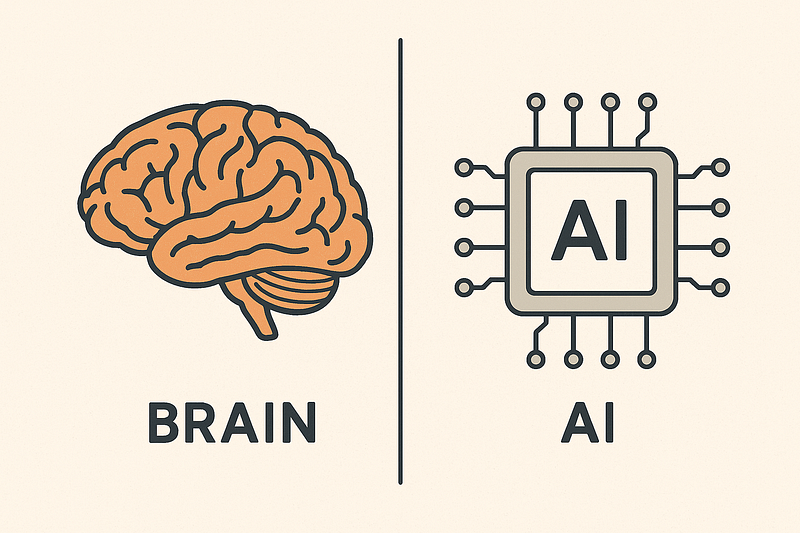
Brain x AI
How the Human Brain Works (In Simple Terms)
Think of your brain as a super advanced, living circuit made up of tiny cells called neurons. These neurons talk to each other by passing tiny electrical and chemical signals. When you learn something new, like how to ride a bike or speak a new word, certain connections between these neurons get stronger. These strengthened connections are your brain’s way of “remembering” things. Scientists call this process neuroplasticity.
Inside the brain, memory is believed to be stored in patterns of these neuron connections, often referred to as neural pathways. These memory patterns are called engrams. When you recall something, your brain reactivates the same pattern of neurons that were active when you learned it.
Here’s a simplified view of the brain’s process, broken into four parts:
- Brain Power: Your brain is always on, powered by billions of neurons firing together. It’s like a 24/7 engine of thoughts, feelings, and perceptions.
- Information: Everything you see, hear, touch, or read becomes input to the brain — raw data for processing.
- Learning: When the brain identifies patterns or makes sense of input, it strengthens neural pathways through repetition and experience.
- Memory and Recollection: Those strengthened pathways (engrams) help you recall what you’ve learned later. The stronger and more connected they are, the easier the recall.In AI, “memory” lives in the model’s parameters — the numerical weights and biases that store what the AI has learned. When you prompt it, the AI draws on this stored knowledge to generate a response.
How an AI Model Works (Also in Simple Terms)
AI, especially something like ChatGPT, is built using a system called a neural network, which is loosely inspired by the brain. But instead of biological cells, AI uses artificial neurons — math functions that take input, apply weights (like importance scores), and produce an output.
When an AI model “learns,” it looks at lots of examples (called training data) and adjusts the weights between its artificial neurons to reduce its mistakes. This process is done using math techniques like gradient descent and backpropagation. Once trained, the AI stores its “knowledge” in these weights — sort of like how your brain stores memories in strengthened neuron connections.
Here’s a simplified view of how AI works, also broken into four parts:
- Neural Networks (and Math Functions): AI uses artificial neurons — mathematical functions that mimic the way biological neurons work. These form the architecture of the model, determining how information flows.
- Deep and Machine Learning: These are the processes through which AI improves itself. Using algorithms, it learns from data by adjusting internal connections to reduce errors.
- Big Data: AI models are trained on massive amounts of information — text, images, and more. This data is essential for recognizing patterns and making accurate predictions.
- Weights: These are numerical values that represent what the AI has learned. Just as the brain strengthens certain neural pathways (called synapses), AI strengthens some mathematical connections using weights. But there’s a key difference: synapses are chemically and biologically complex, influenced by numerous factors like emotion, context, and neurochemistry. Weights in AI, on the other hand, are simple numbers.
For example, if an AI is asked, “What is Paris known for?” and has learned from massive datasets that Paris is the capital of France, the weight between “Paris” and “France” will be strong. But it will also learn that there’s a “Paris” in Texas — though with a lower weight, because it’s referenced less often in that context. These weights help the AI choose the most likely answer depending on the context of the question.
What They Have in Common
- Both learn by adjusting connections: Brains use synapses, AI uses weights.
- Both need experience/data to learn.
- Both produce outputs (thoughts, words, actions) based on inputs (questions, sensory signals).
So yes, AI and the brain share some broad similarities in how they process information and learn.
But Here’s Where They Differ (A Lot)
- Brain is alive: It grows, adapts in real-time, and is influenced by emotion, hormones, and context.
- AI is static: Once trained, most AI models stop learning unless retrained or fine-tuned.
- Brain is always learning: Humans learn from everything — conversations, pain, happiness, sleep. AI doesn’t.
- Brain is energy efficient: It uses about 20 watts of power. Training AI uses thousands of times more.
- Brain is conscious (we think): AI has no awareness, no goals, no feelings. It doesn’t know it’s answering your question.
So Is AI Like a Brain?
Kind of — but not really. AI is inspired by how brains work but doesn’t come close to replicating all the things a brain does. It can recognize patterns, generate text, or solve problems, but it doesn’t “understand” anything the way you do.
The human brain is conscious, emotional, creative, moral, and deeply adaptive. AI is not. Not even close.
Conclusion
AI is an impressive tool, and it’s only getting better. But it is not a brain. Not yet. And maybe never. What it is, though, is a reflection of human intelligence, coded into math and machine.
Understanding this difference helps us use AI wisely — with curiosity, caution, and care.
A message from our Founder
Hey, Sunil here. I wanted to take a moment to thank you for reading until the end and for being a part of this community.
Did you know that our team run these publications as a volunteer effort to over 3.5m monthly readers? We don’t receive any funding, we do this to support the community. ❤️
If you want to show some love, please take a moment to follow me on LinkedIn, TikTok, Instagram. You can also subscribe to our weekly newsletter.
And before you go, don’t forget to clap and follow the writer️!