Coding Isn’t Dying — It’s Evolving Into Cognitive Orchestration
How the rise of AI coding agents shifts the developer’s edge from typing speed to problem framing, validation discipline, and intelligent workflow design.
Disclosure: human-written, AI-assisted.
I remember the exact moment everything clicked. Early 2025, Google dropped their Gemini 2.5 announcement, and I immediately fired up AI Studio to try the build feature. Within minutes, I watched it scaffold an entire React app with authentication, database connections, and API routes. My first reaction wasn’t excitement — it was this hollow pit in my stomach. If a machine can architect and implement faster than I can even outline the requirements, what’s left of what I do?
That existential dread lasted about a week. The more I experimented with various AI coding agents, the clearer it became: the center of gravity isn’t disappearing — it’s moving up the stack. The craft isn’t vanishing; it’s concentrating into higher-leverage decisions that machines can’t make for us. At least not yet.
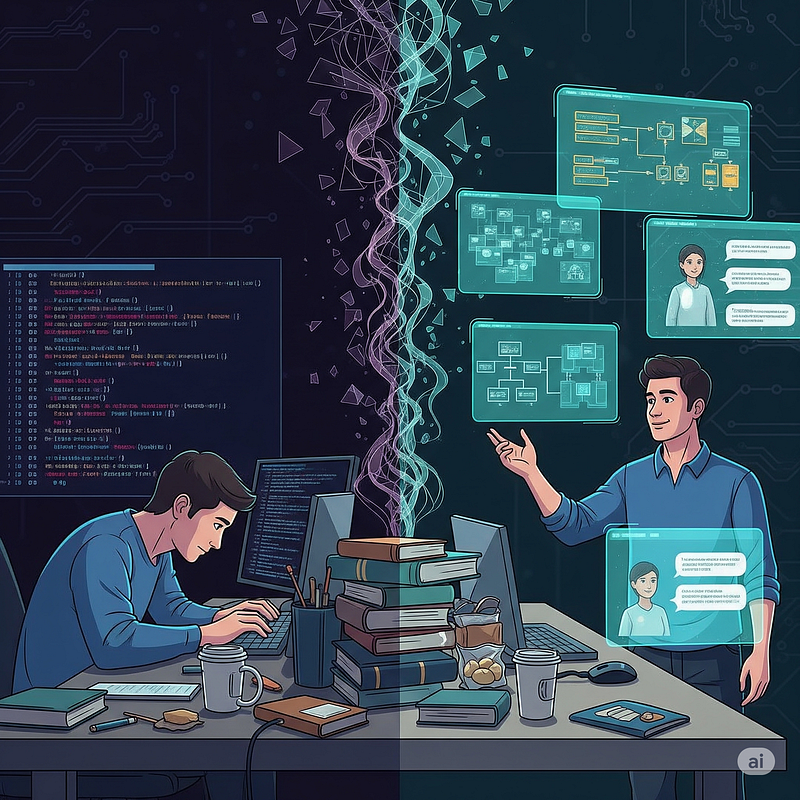
Coding with AI moves a developer past just coding, involving engineering the prompt and context, assisting LLMs, automating workflows and orchestrating multiple agents and tools. Generated with Gemini 2.5 pro.
The Shift: We Were Never Just Typists
Here’s the thing — the keyboard was never where the real value lived. The leverage has always been in:
- Breaking down complex problems into solvable pieces
- Making conscious trade-offs between competing priorities
- Surfacing implicit assumptions before they become bugs
- Maintaining quality, security, and performance standards across systems
AI agents just made this brutally obvious. They’re incredible at routine scaffolding, boilerplate adapters, test shells, and other automatable grunt work. But context setting, risk assessment, system boundaries, domain nuance? That’s still our territory, and now it’s proportionally more important.
Think about the transition from assembly to high-level languages. We didn’t lose the craft — we raised its altitude. Now we’re making another leap: the interface is becoming natural language plus constraints, backed by tight feedback loops with increasingly capable agents.
My Emerging Skill Stack (What Actually Matters Now)
After months of messy experimentation, I audited what still felt like genuine leverage. Here’s where I’m doubling down:
Problem Framing: Writing crisp specs before any code gets generated. Not just “build a user dashboard” but “build a user dashboard that handles 10k+ records with client-side filtering, preserves state on navigation, and gracefully degrades without JS.”
Context Curation: Instead of dumping entire files at models, I’m getting surgical — diffs, type signatures, specific error logs. Quality in, quality out.
Validation Discipline: Treating tests and invariants as part of the “prompt” rather than afterthoughts. If I can’t express what success looks like, neither can the AI.
Multi-Agent Orchestration: One primary editor assistant, one fallback CLI agent. No tool churn, no shiny object syndrome.
Critical Review: Using AI to explain failing code, not to blindly overwrite it. The learning happens in the explanation.
Outcome Metrics: Tracking iteration count, rollback risk, and time-to-working-feature — not just lines of code generated.
My 90-Day Experiment (The Plan I’m Actually Following)
Full transparency: this isn’t battle-tested wisdom. It’s the framework I’m using right now, and I’m sharing it because I think some of you might want to run a parallel experiment.
Days 1–7: Stabilize Your Stack
Lock in one primary editor-integrated assistant (I’m using Cursor) plus one fallback CLI agent (Claude Code is my current pick). Commit for 30 days minimum — resist the urge to tool-hop every time something new drops.
Configure pre-commit hooks: formatting, linting, static analysis. If the machine is going to generate code at volume, your quality gates need to be automated.
Create 5–10 “golden prompts” that you’ll reuse: task-to-plan templates, diff request formats, failure analysis frameworks, test generation patterns, refactor blueprints.
Days 8–30: Ship With Discipline
Build 2–3 real features using this flow: Spec → Plan → Small Diff → Tests → Minimal Fix. Track your metrics: percentage of AI-generated lines, PR cycle time, iterations per task, test coverage changes.
Start a lightweight /docs/ai-playbook.md in your repo. Document your best prompts, common gotchas, and examples that worked well with your specific codebase. This becomes your knowledge base as patterns emerge.
The goal here: reduce first-cut regenerations. If you’re constantly asking the AI to try again, your prompts need work.
Days 31–60: Harden Your Process
Introduce property-based tests for your core logic paths. These catch the edge cases that AI often misses in its eagerness to ship.
Enforce a “3-iteration rule”: after three failed AI attempts on any task, solve it manually and then use AI to review your diff. This prevents rabbit holes and keeps you sharp.
Start cataloguing recurring error patterns. I’m already seeing predictable failure modes: state mutation bugs, race conditions, missing error boundaries. Your codebase will have its own patterns.
Days 61–90: Scale What Works
Add retrieval/embeddings, but only for navigation and summarization — never for bulk generation. The goal is helping AI understand your codebase context, not generating more code faster.
Automate the boring stuff: PR templates, changelog drafting, release note summaries. Let AI handle the formatting while you focus on the substance.
Evolve your golden prompts into reusable scaffolds: failure taxonomy templates, risk assessment matrices, refactor decision trees.
The focus shifts from pure speed to preserving reasoning so future-you isn’t blind to why decisions were made.
My Current Workflow Blueprint
This is what’s actually working for me day-to-day:
- Frame the Task: 150–300 word spec with goal, constraints, interfaces, and acceptance criteria. Not negotiable.
- Ask for a Plan First: Request steps, edge cases, and contracts before any code generation. Approve or refine before moving forward.
- Constraint Generation: One or two files per diff maximum. If the change is larger, I ask for a patch plan first.
- Validate Early: Generate tests alongside implementation, not after. If the AI can’t express what the code should do, it probably shouldn’t write the code.
- Close the Last 20% Intentionally: Use AI to explain failing tests, then request minimal diffs instead of complete rewrites.
- Preserve Reasoning: Maintain a
DECISIONS.mdfile. Keep the "why" outside of ephemeral chat buffers.
Quality Guardrails (The Real Leverage Multipliers)
What gave me confidence to lean harder on AI wasn’t better prompts — it was stronger guardrails:
- Static gates: Lint, type check, and format on pre-commit. Non-negotiable.
- Property-based testing: For complex data transforms and business logic.
- Failure taxonomy prompts: “List plausible failure modes for this implementation and propose a test for each.”
- Self-critique passes: Have the model audit its own diff against your acceptance criteria before you run anything.
Prompts Worth Stealing
I’ve cycled through a lot of fluffy prompt engineering. Here’s what actually works:
Task → Plan: “You are my senior pair programmer. Summarize this problem, propose a 5–8 step implementation plan, list your assumptions, and name the interfaces you’ll touch. If anything is ambiguous, ask clarifying questions first. Keep it under 200 words.”
Diff-Only Generation: “You’re editing an existing repo. Output a unified diff touching only the files you specify. Keep changes minimal, preserve existing style, include tests in the same diff. If this spans more than 2 files, first output a change plan with filenames and rationale.”
Failure Focus: “Given this failing test output and the previous diff, propose the smallest code change to make it pass. Explain what invariant was violated and why this change is safe. Return only a diff.”
Pre-Merge Checklist: “Before we merge: validate logging levels, error messages, boundary conditions, resource cleanup, idempotency, and thread/async safety where applicable. List anything still risky and suggest targeted tests.”
My Decision Tree (When to Use What)
- Boilerplate adapters, DTOs, CRUD scaffolding, test shells → AI first
- Concurrency primitives, performance hotpaths, security-sensitive logic → Human first, AI as reviewer
- Cross-cutting refactors → AI for impact mapping and risk assessment, I apply the sequenced diffs
- Edge case discovery → AI to enumerate scenarios, I codify the tests and fixes
The Mindset Shift
I’m not competing with the model’s token generation speed — I’m amplifying my judgment. My advantage has migrated to:
- Faster, clearer intent transmission
- Designing constraints that channel generation toward useful outputs
- Turning validation into a creative act rather than a chore
- Building systematic learning loops across similar tasks
The reward curve is nonlinear: better framing leads to better first drafts, which means fewer iterations, which compounds into seriously improved velocity.
Getting Personal for a Second
That early unease I felt — “Is my craft dissolving?” — completely flipped once I realized the bar hasn’t been lowered, it’s been moved. Routine code output is now table stakes. Synthesis, stewardship, and strategic constraint design are the new differentiators.
Coding skill now includes fluency in extracting precise, reliable leverage from AI agents. That’s not a lesser skill — it’s a different kind of mastery.
Your Turn
Here’s my challenge: run a 7-day experiment. Pick one medium-sized feature. Write a tight spec, demand a plan first, constrain your diffs, generate tests in parallel, and log your metrics (iterations, failures caught pre-merge, time to working code). Compare it against your last purely manual feature.
Then scale what worked. Archive what didn’t. Let data replace the vibes.
Because coding isn’t disappearing — it’s graduating. And frankly, the view from up here is pretty good.
What’s your experience been with AI coding agents? I’m curious whether my workflow resonates or if you’ve found completely different patterns that work. Drop me a line — I’m still iterating on this stuff and would love to compare notes.
A message from our Founder
Hey, Sunil here. I wanted to take a moment to thank you for reading until the end and for being a part of this community.
Did you know that our team run these publications as a volunteer effort to over 3.5m monthly readers? We don’t receive any funding, we do this to support the community. ❤️
If you want to show some love, please take a moment to follow me on LinkedIn, TikTok, Instagram. You can also subscribe to our weekly newsletter.
And before you go, don’t forget to clap and follow the writer️!